
Based on over fifteen years of bodywork and energy work experience by Guy Harriman, these energetic therapies include medical chi gong, crystal work, reflexology, craniosacral, Thai massage, and tok sen techniques. These body-centered modalities are skillfully combined with spiritual, psychological and emotional support, in tune with the individual's soul journey.
This unique blend of powerful bodywork techniques acts in synergy to release physical and energetic blocks in the client's body. Guy tunes in to each client individually, and listens to the client's body throughout each session. One side of the body often has different blocks than the other side, and so the approach is varied accordingly. Even with the same client, one session may be significantly different from another.
Mind-Body Therapies
Visionary Reiki:
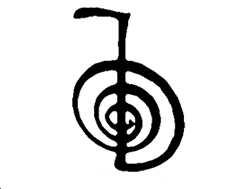
Children up to the age of about five years naturally feel the chi, as do adults in cultures which remain connected to energy. Animism is still very common in south East Asian countries in particular, as well as in China and India amongst the poorer rural population. However, for those rasied in the western materialistic culture, many lose the awareness of energy they had a young children, before the mental focus became dominant. Therefore bringing awareess to the real feeling of energy is valuable as part of receiving and learning reiki.
Guy has developed the ability to receive information at the soul level about his clients and students in the form of visual images. This developed as a result of the attunements he received in a number of yogic traditions in the 1990s in California, as well as his committed daily practice simce then in honor of the traditions, as well as Tibetan Chi Gong. So although he does not formally act as a psychic or medium, he can describe the images he sees when connecting to client's auras, and often this is directly related to past lives or the spiritual issues the client is currently working on.
Reiki is a beautiful and simple way of connecting to the soul, and the receiver is taken on a soul journey as they allow the channelled energy to flow. Through the use of reiki symbols, the receiver connects to source energy (that is, to spirit or god, depending on the words you prefer to use). It is a facilitation of entering the meditative state, and so is deeply healing for the mental body, emotional body, energy body, as well as the physical body.
Crystal Healing:
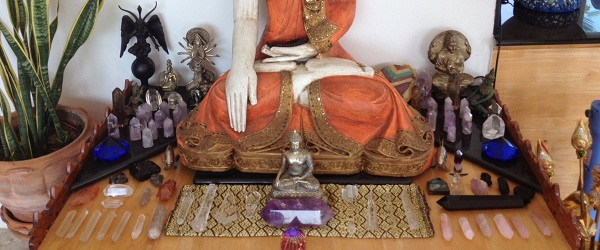
Crystals are powerful tools for healing the aura, which is the subtle energy field surrounding the body of all living beings. The ability of crystals to order energetic information, and amplify the flow of chi, facilitates the energetic healing process. Guy often uses crystals in healing processes by asking the client to select one or more crystals from the altar (shown above). The crystals are placed in the palm of the hands, or elsewhere on or neart the body (for example, on the chakras). Often the receiver goes into deep meditation during th ecrystal helaing, and the soul communicates with the higher slef through the gateway of the receiver's heart in order to do the healing work. Many clients receive spiritual insights, or connect with guides and receive insights ad information during the crystal healing.
Crystals are being recognized more widely by spiritually open people to be a wonderful tool to help integration and alignment with their soul journey at this time. Guy has lived with the big crystals in the Healing Centre since 1999, after his return from Egypt, where he had a very powerful initiation while aying inte sarcophagous of the King's Chamber of the Great Pyramid at Giza. Guy is happy to share the wonder and joy of working with crystals with you. He feels very blessed to be the keeper of the crystals, and knows that part of his mission at this time is to share these crystal's wisdom with you.
Emotional Healing:
At the root of many physical and spiritual bocks or diseases are the emotional imbalances whcih are programmed deep into the unconscious mind at the emotional level. Often people struggle to maintain health and balanc in their ;lives as a result of these emotionmal patterns. Psychology and hypnotism offer verbal methods to access these issues, through intellectual insight and the forming of new programs which are more positive, but very often this does not shift the root issues.
Guy's approach is to combine energetic work with the verbal counselling, so the blocks clear at the root of the issues, that is in the emotional or soul levels, depending on whether the issues are related to the current life (blocks known as klieshas in yoga therapy) or past lives (blocks known as samskaras in yoga therapy).
As in all therapies, the client is in charge of the process, and needs to be willing and feel safe at a deep level to shift embedded behaviors, as these behaviors appear to the ego to have great survival value. Although rationally the persona is no longer a scared or overwhelmed child in a threatening family or early social situation, the behavor once triggered plays out in the same way as it was felt in early childhood. Therefore Guy's primary objective is to create a safe and caring environment where the client can feel heard and respected, and to empower the client to be in charge of the depth of the therapeutic process. Emotional healing is one of the most difficult processes to truly embrace, and therefpre requires insight and self-acceptance to proceed. The yogic/buddhist approach which Guy uses facilitates this, and is done with respect and intuitive understanding of the individual client, based on Guy's extensive experience with this kind of healing work.
Sound Healing:
Ancient Shamanic healing often incorporates the use of sound. As the fetus develops during the nine months in utero, the constant sound vibration felt and heard is the beating of the mother's heart. All life is based on cycles, and the rhythm of drums reminds us at the deepest internal level of the mother's heart beat while we grew in the safety of the uterus.
Guy uses singing bowls, drums, flutes, gongs and other percussion instruments in the Healing Center's magical resonant space to take the client on a soul journey. Often the client goes into a deep trance state. In this state there is no awareness of time, and the conscious mind is switched off. This is a theta or theta/delta brain state, in which the deep relaxation of the client allows the soul to be gathered together again and re-integrated.
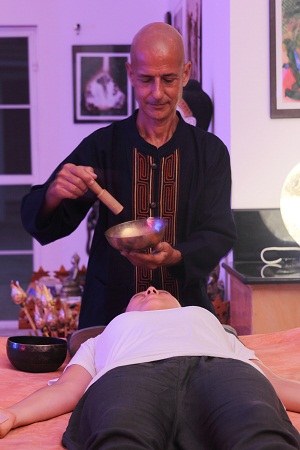
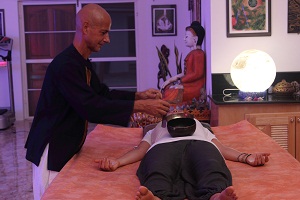 Singing bowls have been used for a long time in Tibet for sound healing. The Tibetan shamans (in the pre-Buddhist animistic Bon religion), and later the Tibetan Tantric Buddhist monks (vajrayana tradition) understood the value and purpose of trance induced through sound to invoke altered states of consciousness, and out of body experiences, for soul healing. Once the soul heals and re-integrates, the mind and body can follow; if the soul remains unhealed, then other therapies have little effect, and the body and mind soon revert to the original post-trauma state of soul loss. Only by healing at the deepest level of the soul can we experience permanent clearing of karmic imbalances in our being.
Reflexology:
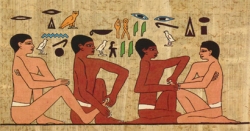
Reflexology is an ancient art, thought to have originated as a Taoist practice over 5000 years ago in China, and recorded 2500 years ago in Egypt. One of the tombs in the Valley of the Dead is the physician's tomb, the tomb of Ankhmahor in Saqqara. The tomb's pictographs include circumcision, childbirth, pharmacology, embalming, dentistry, and reflexology. On the reflexology pictograph the therapist is holding a tool in his hand for working on the feet. Underneath the picture it is written, "doctor: 'Make these give strength' patient: 'Do not cause pain to these' doctor: 'I will do thy pleasure'" Reflexology accesses organs and internal structures in the body through the use of the bio-holograms found in the feet (also found in the hands, irises, and ears).
A typical modern reflexology practitioner has been taught to spend about the same time on all the major reflex points in the feet. However, through his own experimentation, Guy has discovered two aspects of reflexology. The first is diagnostic, where the client's sensitivity indicates the amount of energy blockage in the body structure. The sensistivity is related to the length of time the blockage has been held in the client's body, and to the acuteness of the imbalance. The second aspect is the release of the energy blockage, which can take a number of minutes, and involve different levels of pressure to avoid pain. Therefore a therapeutic reflexology session can take up to two hours, but regular sessions build on the work done in previous sessions, as further detoxing and clearing is done in the energy system. An onion skin effect is observed, where applying pressure to the same point releases recent blocks first, becoming relaxed and balanced, while further sessions reveal older and deeper blocks, until the trauma profile is completely cleared for that point. It is also possible for very old patterns to be desensitized, and slow, patient work is needed to remove this mental shielding of suppressed trauma.
CranioSacral:
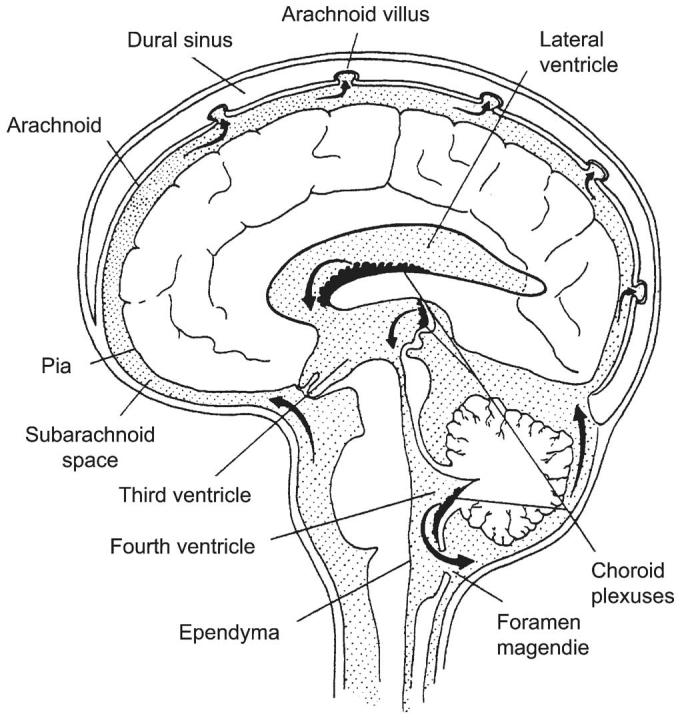
The craniosacral practitioner tunes into the CSR pulse in the client's body, using the non-linear proprioceptors in the practitioner's hands which can feel minute movements in the bones of the client. These propiioceptors can be trained to respond over a range geater than a million to one. The THM wave is controlled by the autonomic nervous system, reflecting the ratio of parasymathetic to sympathetic state in the client. This ratio is reduced under chronic stress and increased through meditative practices. Stress is also reflected in the wave of respiratory sinus arrhythmia, the variation in the heart rate corresponding to breathing, which similarly affects the CSR. By successfully entraining to the CSR pulse, the therapist may be able to influence it, and bring balance to areas which are not moving freely as the result of previous physical or emotional trauma.
The CSR pulse may be picked up anywhere in the body, which makes it ideal for helping to release the energy blocks found in reflexology, for example. Now gaining more recognition for its ability to allow the client to deeply relax and release energetic blocks related to stress and trauma, craniosacral therapy is gentle, meditative, and can be profoundly effective.
Distant Healing:
Fundamental to an undrestanding of quantum physics is the acceptance of non-local action, which was demonstrated in the 1960s through biophotons and experiments with DNA. To quote the link:
"Experiments have even revealed that persons with deceased cells may be healed remotely by those who transmit coherent states of information via biophoton transmission. Popp says, "Biophotons are photons emitted spontaneously by all living systems."
Distant healing is a process of profound surrender of outcome by the intellect of both sender and receiver, and acceptance of the wisdom of the soul and higher self in the outcome. This is a purely meditative type of therapy which is subtle and profound, and teaches humility and detachment to both the sender and receiver.
Medical Chi Gong:
This healing modality is still used in China as part of traditional Chinese medicine. When a practitioner has developed the ability to move chi as a result of long term practice of chi gong, he or she moves this chi field through the client's body to clear blocks and balance the meridians of the client.
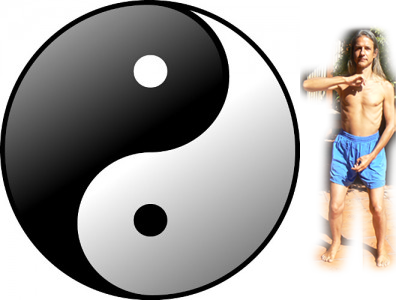
Medical chi gong is a meditative energy practice, and can be deeply relaxing for the client when the client tunes into the energy flow. In particular, it is helpful for clearing headaches, stomach aches, and injuries in the body. Pain often melts away during a medical chi gong session.Guy has demonstated many times that bruises, burns and other skin trauma such as edema visibly clear in a few minutes by projecting chi into the affected area.
Tok Sen:
Tok Sen means "take off energy" in Thai, in other words it is a technique to clear blocked energy. Tok Sen uses mechanical and sound vibration, working deeply through the fascia and muscles. Tok Sen is an oral tradition, used by the farming families over many generations. It uses a wooden stick, hit with a matching mallet, to send sound vibrations into the clients body. The effect is unique, and has proven to be powerful for releasing long-held knots, as well as old injuries. It is also an energy practice, like acupuncture. The energy carried by the sound vibrations reaches deep into the body, and in this way clears old and deeply held energy blocks in the client's body.
This youtube video shows Guy teaching a one day seminar on Tok Sen in San Fransisco, during June 2009: